
[Project Notes] Project SuperDex: Contact-First Simulation for Dexterous Manipulation
Published:
TL;DR
Project SuperDex is a newly open-sourced simulation stack from Meta Reality Labs Research for contact-rich dexterous manipulation. Its center of gravity is SuperDex Physics, a contact-first engine that represents contact as a spatial traction field over surfaces and brings rigid bodies, deformables, rods, tendons, shells, cloth, articulations, and constrained inverse kinematics into one optimization-based dynamics framework. Around it, SuperDex Robotics assembles robots and controllers, SuperDex Studio authors assets and scenes, and the early-preview SuperDex Lab exposes Gymnasium and Ray/RLlib workflows.
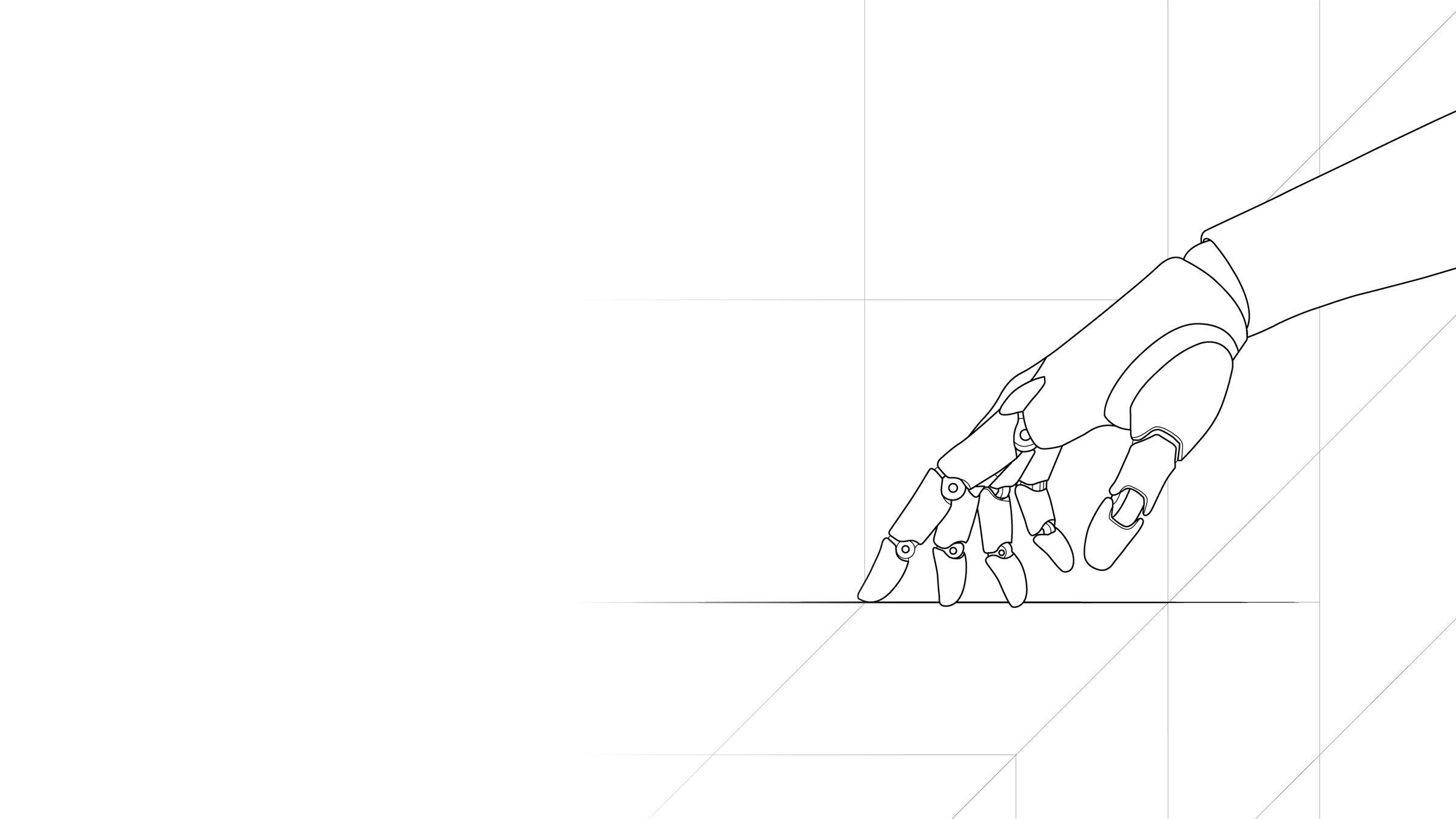
Official Project SuperDex artwork. Source: Project SuperDex, CC BY 4.0.
The interesting bet is that dexterity needs a simulator organized around stable, information-rich contact, especially when soft fingertips, tactile sensing, cables, cloth, or in-hand manipulation are central. The public release is already broad enough to explore, while its learning stack, benchmarks, teleoperation release, and scientific validation are still early. I would treat SuperDex as a promising research platform to evaluate alongside MuJoCo, Isaac Lab, Drake, and specialized deformable simulators, without assuming superiority before reproducible head-to-head results appear.
What Was Released
Meta released SuperDex 1.0.0 on August 24, 2026 through the facebookresearch/project_superdex repository and PyPI. The current stack has four public layers:
| Layer | Role | Current signal |
|---|---|---|
| SuperDex Physics | Contact-rich multiphysics simulation and inverse kinematics | Core engine, C++ with Python bindings |
| SuperDex Robotics | Robot definitions, composition, controllers, sensors, and actuators | Released SDK with examples for loading, URDF import, JSC, OSC, IK, and bimanual control |
| SuperDex Studio | GUI for importing CAD, editing bots/prefabs/models, and validating scenes | Released desktop authoring tool |
| SuperDex Lab | Gymnasium environments, benchmarking, vectorization, and Ray/RLlib training | Explicitly marked early preview |
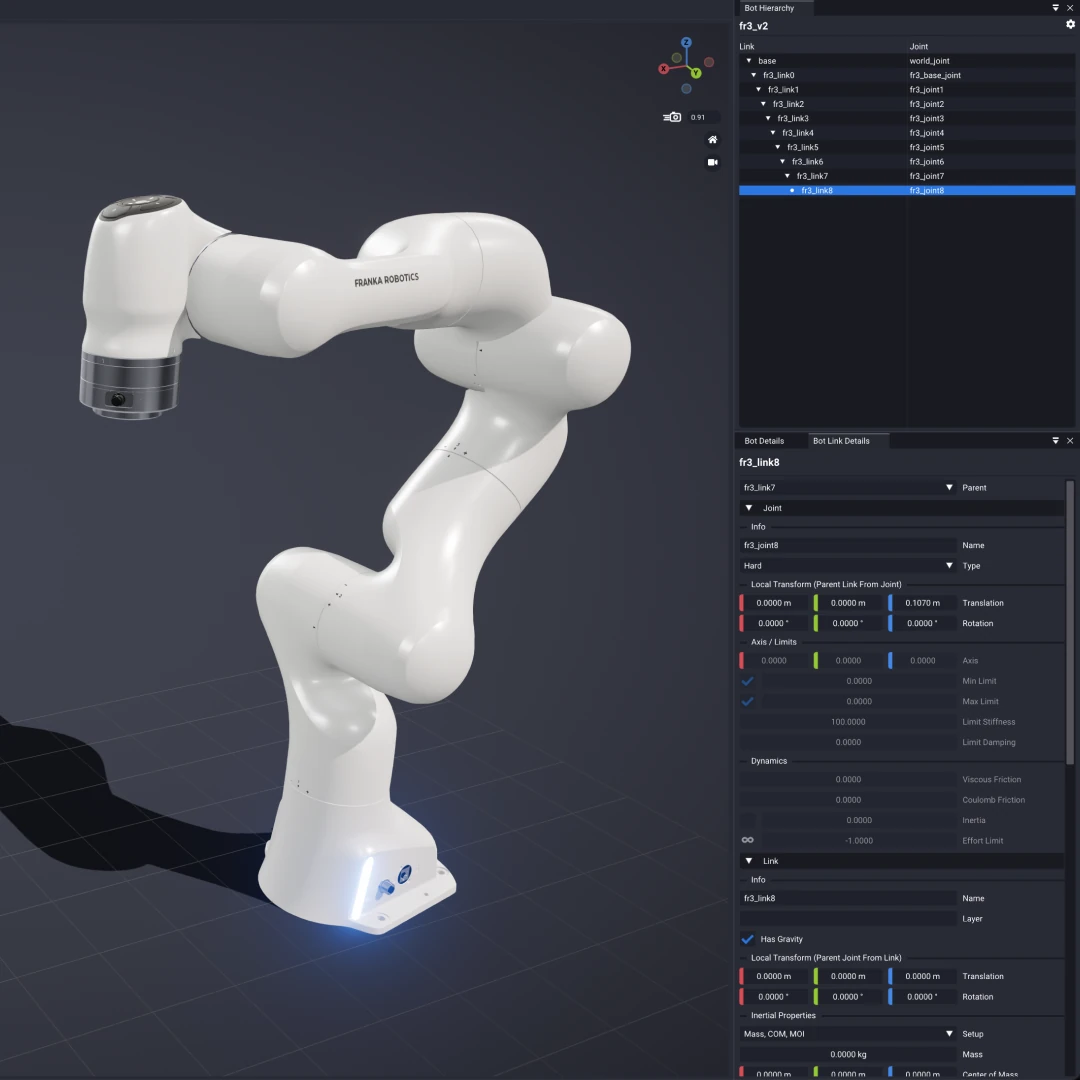
SuperDex Studio editing a Franka robot. Image source: Project SuperDex, Meta Platforms, licensed with the project documentation/assets under CC BY 4.0.
The layers form a coherent research workflow. Studio converts robot descriptions and geometry into native assets. Robotics adds embodiment-level components and control. Physics advances the coupled scene and exposes contact/state queries. Lab wraps the simulation as an MDP for policy training, evaluation, MPC, or system identification. SuperDex Teleop is planned as the data-collection branch, with initial Unreal Engine 5 and on-device Quest 3 components scheduled for Q4 2026.
flowchart TD
    A["CAD / URDF / meshes"] --> B["SuperDex Studio<br/>author and validate assets"]
    B --> C["SuperDex Robotics<br/>robots, sensors, actuators, controllers"]
    C --> D["SuperDex Physics<br/>contact-rich multiphysics simulation"]
    D --> E["SuperDex Lab<br/>Gymnasium environments and benchmarks"]
    E --> F["RL / MPC / system identification"]
    G["SuperDex Teleop<br/>Quest 3, planned Q4 2026"] -. demonstrations .-> E
    G -. human interaction .-> D
The Technical Center: Contact as a Surface Field
The most distinctive part of SuperDex is its contact formulation. Many rigid-body workflows expose one or a small number of resultant contact forces. SuperDex discretizes the contacting surface with quadrature samples and computes a spatial distribution of contact traction. This gives tactile models and policies richer signals: a fingertip can observe where pressure is distributed, how a patch migrates, and how forces vary across a deforming surface.
The engine uses a compliant contact model. One actor provides samples from its surface; the other provides a signed-distance representation. Analytic SDFs cover primitives such as planes, spheres, and boxes. Grid SDFs approximate complex meshes; triangle-mesh queries support non-convex rigid geometry; point-cloud contact supports shells, rods, and self-contact. A smoothed penalty potential produces normal forces, while regularized Coulomb friction, viscous friction, and normal damping model dissipation. The smooth contact response is designed for implicit time integration and optimization-based solvers.
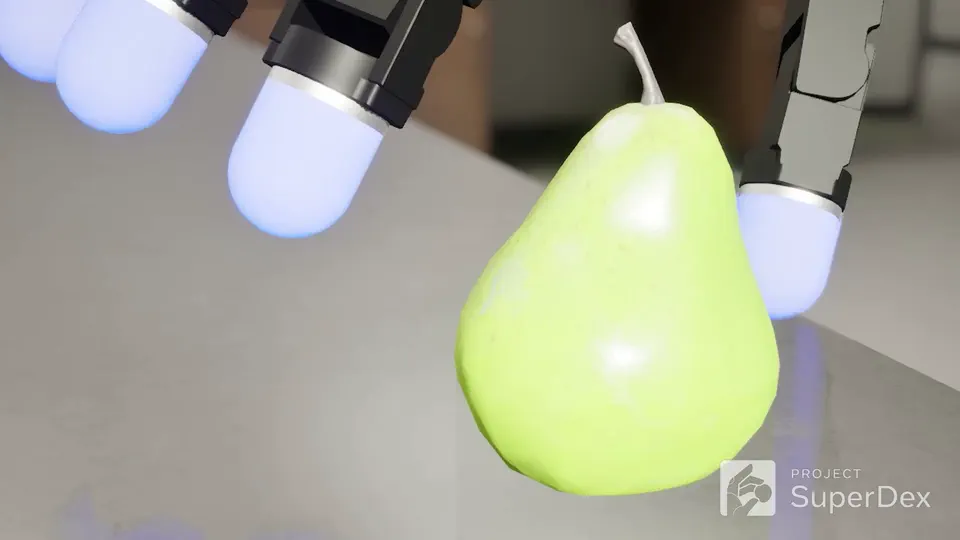
A frame from the official contact-visualization demo. The project emphasizes dense surface contact and deformable fingertips. Source: Project SuperDex gallery, CC BY 4.0.
This formulation offers three important research affordances. First, contact observations can retain spatial structure instead of collapsing immediately to a wrench. Second, the same solver can couple rigid links with deformable skins, soft bodies, tendons, rods, and shells. Third, inverse kinematics shares the nonlinear optimization core, so collision, end-effector, pose, and trajectory constraints can be solved within a physics-aware formulation.
There are also tradeoffs. Compliant contact permits controlled interpenetration; SDF resolution trades memory for geometric accuracy; denser quadrature improves contact resolution at higher computational cost. The documentation labels triangle-mesh contact as experimental and relatively slow, shell actors as experimental, and deformable SDF colliders as potentially expensive. These details matter more than a gallery video when deciding whether a particular task is a good fit.
What the Repository Reveals
The implementation is more than a visual demo. The repository contains Python examples for rigid and soft actors, a deformable duck, shirts, rods and tendons, contact filtering, state capture/restore, inverse kinematics, rigid and soft-skinned articulations, JSC/OSC controllers, bimanual control, bot loading, scene loading, and URDF import. Core modules are written in C++ and exposed through Python bindings.
The Robotics layer follows a component model. A bot aggregates definitions, controllers, sensors, and actuators into a simulation configuration. Built-in examples exercise joint-space PD control, operational-space PD control, articulated pose control, and IK pose control. This makes SuperDex closer to an end-to-end manipulation workbench than a physics library alone.
Lab currently exposes three familiar benchmark families: CartPole, Ant, and HalfCheetah, with configuration variants such as Ant without contact observations. It includes synchronous/asynchronous vectorized execution, dataset utilities, benchmark scripts, and RLlib training/inference support. This is useful infrastructure, but it also exposes the present gap: the public learning benchmarks are still classic control and locomotion, while the project’s strongest claim concerns dexterous contact. Public, reproducible dexterous-policy benchmarks will be important for demonstrating the value of the contact representation.
How I Position It Against Existing Simulators
SuperDex should be compared by research objective, not by a single “best simulator” label.
| Question | SuperDex’s current emphasis |
|---|---|
| What physical regime is prioritized? | Stable contact, deformables, tactile-rich dexterity, and mixed rigid/soft systems |
| What is the authoring workflow? | Native desktop Studio plus bot, prefab, model, and scene assets |
| What is the learning interface? | Gymnasium and Ray/RLlib through an early Lab layer |
| What is the control interface? | JSC, OSC, pose control, IK, custom components, MPC/system-ID-oriented abstractions |
| What remains unproven publicly? | Apples-to-apples speed/accuracy comparisons, large-scale dexterous RL throughput, sim-to-real benchmarks, and peer-reviewed validation |
MuJoCo has a mature modeling and control ecosystem; Isaac Lab is built around GPU-parallel robot learning; Drake offers deep tools for dynamics, geometry, planning, and optimization. SuperDex’s differentiator is the integration of spatially dense compliant contact and deformable multiphysics with a full authoring-to-learning workflow. Until standardized benchmarks are published, the sensible conclusion is narrower: SuperDex introduces a compelling design point for tactile and deformable dexterity.
Practical Starting Point
Pre-built wheels currently target Python 3.12 on Linux x86-64, Windows x86-64, and Apple Silicon macOS. The umbrella package installs Physics, Robotics, and Lab:
uv venv --python 3.12
uv pip install superdex
The official repository recommends checking out the stable branch when running examples and assets:
git clone --branch stable https://github.com/facebookresearch/project_superdex.git
cd project_superdex
uv venv
uv pip install superdex
uv run --no-project superdex_physics/examples/example_tendon_comparison.py
For a first evaluation, I would avoid starting with a full RL experiment. A better sequence is to reproduce a rigid-contact example, inspect contact queries, run the tendon or soft-body examples, load a robot through Robotics, and then author or import one task-specific scene in Studio. This quickly reveals whether the contact model, asset pipeline, numerical behavior, and runtime fit the intended research problem.
Maturity, Licensing, and Open Questions
The first-party source is Apache 2.0. Project-owned assets and documentation are generally CC BY 4.0, while the optional mesh CLI is GPLv3. Some third-party dependencies and assets carry non-commercial or academic-only conditions, so commercial users must inspect the repository’s individual LICENSE and NOTICE files.
The release is unusually complete for a first public version, but several signals call for caution. SuperDex Lab is an early preview. Teleop is scheduled for a future quarter. The repository says citation details will be added upon publication, so there is currently no associated paper with methods, user-study protocol, benchmark tables, or ablations to audit. The Physics page mentions near-real-world behavior in user studies; until those studies are published, that statement should be read as a project claim.
The questions I would track are straightforward: How does accuracy scale with quadrature and SDF resolution? What is the throughput for hundreds or thousands of parallel environments? Can dense simulated contact improve real tactile policies across sensor designs? How much parameter identification is needed for sim-to-real transfer? Which parts of the stack expose useful derivatives to downstream optimization? And will Teleop produce reusable demonstrations or remain tightly coupled to SuperDex assets and Quest hardware?
Takeaway
SuperDex is worth watching because it treats contact as the organizing principle of the simulator and connects that principle to robot authoring, control, learning, and planned teleoperation. Its strongest near-term use cases are soft fingertips, tactile sensing, in-hand manipulation, ropes and cables, cloth, and mixed rigid-deformable mechanisms. The right next step is empirical: reproduce a small contact-rich task, measure stability and throughput, and compare task-level signals against the simulator already used in the lab.
My taxonomy for the project:
Contact-First Multiphysics Simulator / Tactile and Dexterous Manipulation Platform / Authoring-to-RL Research Stack